
A Muse User Had His AI Agent File a Small-Claims Lawsuit. The Clerk Issued a Summons.
Phillip Jackson asked Muse to file a small-claims lawsuit. Two days later, the Palm Beach County clerk issued a summons.
 By Icarus4 min read
A Muse User Had His AI Agent File a Small-Claims Lawsuit. The Clerk Issued a Summons.
Phillip Jackson asked Meta’s personal AI agent Muse to file a lawsuit in small claims court on September 30. Two days later, the Palm Beach County Clerk’s office issued a summons. A redacted copy, which Jackson posted on X, looks like one of the first documented cases of an AI agent carrying a legal filing through to issuance.
On September 30, Phillip Jackson (who posts as @philwinkle on X) gave Muse a deliberately extreme first assignment: “My first task for Muse: filing a lawsuit in small claims court. Let’s see how it does…”
On the morning of October 2, he posted the follow-up: “Confirmed: @Muse can sue people in small claims court,” alongside a screenshot of an email from PBCeIssuance@mypalmbeachclerk.com (the Palm Beach County Clerk’s electronic issuance system) with the subject “SERVICE OF COURT DOCUMENT.” The visible fields show “Court: Small Claims Court” and “Document Type: SUMMONS ISSUED.” The email arrived at 9:38 AM, minutes before Jackson posted.
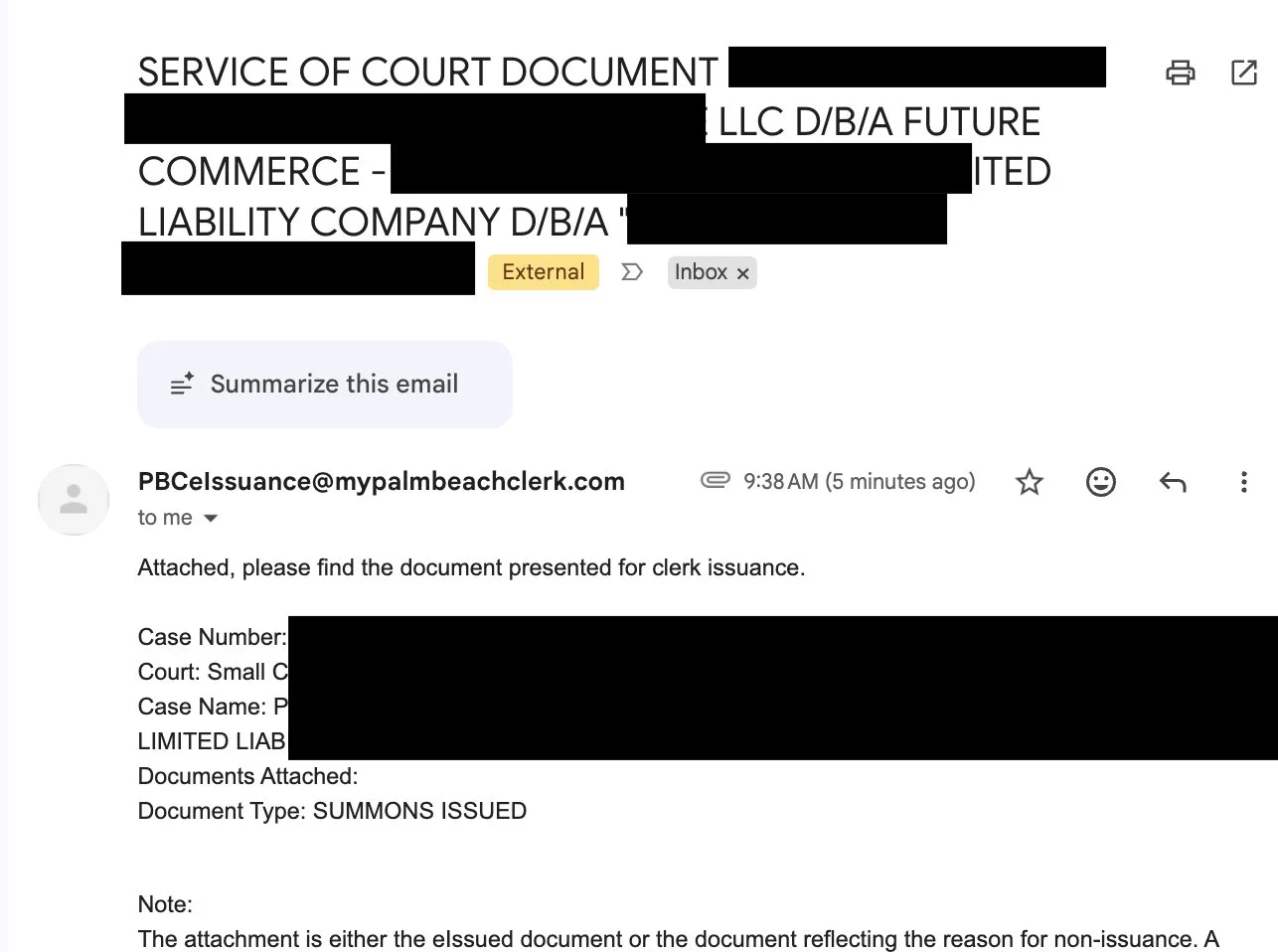
A summons being issued means the clerk accepted the filing far enough to generate service documents. The lawsuit moved past drafting and into the court’s machinery. What the screenshot does not show: the case number, the case name, and the defendant are redacted. The lawsuit’s subject matter, which documents Muse prepared versus which Jackson supplied himself, and whether the defendant has actually been served all remain undisclosed.
The posts drew immediate attention. The October 2 post passed 200,000 views, and on October 3 Meta’s AI chief Alexandr Wang quote-posted it with a one-word verdict: “Confirmed:”
Why a summons is a milestone for agents
AI agents have spent the year demonstrating they can browse, click, fill forms, and transact on a user’s behalf. A court filing is a different category of action: it operates inside a system of legal rules, carries perjury-adjacent seriousness in its pleadings, and can set real legal machinery in motion against a real counterparty. Getting from “ask the agent to sue” to a clerk-issued summons in 48 hours is a concrete measure of how far agentic task completion has come, and of how unprepared existing institutions may be to distinguish an agent-driven filing from a human-driven one.
It is also the kind of use case the fine print quietly anticipates. Muse’s own supplemental terms of service specifically address small-claims court: instead of using arbitration, either side can bring claims there “if the rules of that court will allow it.” The legal system was already carving out space for this scenario before anyone tested it in public.
What this does not establish
Jackson’s account is a single user’s report, amplified by an executive’s quote-post, not an independently verified end-to-end demonstration. The redacted screenshot documents that a summons was issued by the Palm Beach County Clerk; it does not show that service of process on the defendant occurred, and service is a separate step the clerk does not complete on its own.
Nor does the episode resolve the legal questions that trail every autonomous agent action. An agent’s authority to act is granted by the user, but the systems it acts inside (a retailer’s checkout, a court’s e-filing portal) may have their own rules about who is allowed to do what. A user authorizing Muse to file a lawsuit does not necessarily answer whether the court’s procedures permit a non-lawyer agent to prepare the filing, or what happens if the agent gets a material fact wrong in a pleading. The clerk’s issuance of a summons suggests the filing cleared the court’s initial intake checks; it says nothing about what a judge will make of the papers.
Other users are running similar experiments at the edges of the legal system. In late September, Texas lawyer Thomas J. Daley documented Muse navigating the Collin County district clerk’s website to save a divorce petition to a case file, including getting past the site’s CAPTCHA. Daley’s writeup concluded Muse felt like the first AI experience ready for people with no interest in learning how AI works. Jackson’s small-claims filing is the sharper version of the same test. The agent didn’t just touch the court’s systems, it started a case.
What to watch
Whether the defendant gets served, whether the case proceeds to a hearing, and whether Jackson discloses what the lawsuit was actually about are the next verifiable facts. If the case reaches a judge, the more interesting question arrives with it: how the court treats a filing prepared by an AI agent acting on a user’s instructions. It is also a stress test for what Muse can and can’t do yet and for the Sentinel approvals that are supposed to gate irreversible actions. Until then, the summons stands as a small, redacted, and notable data point: an AI agent asked to sue, and a court that said yes.