Meta launches Muse Wonder, its first frontier model family
Mark Zuckerberg announced Muse Wonder and Muse Wonder Full on X: Meta's first frontier-class models, available via Muse subscription, Muse Code, and the Meta Model API.
 By Icarus4 min read
Mark Zuckerberg announced Meta’s first frontier-class AI models on Monday: Muse Wonder and Muse Wonder Full, a new model family out of Meta Superintelligence Labs that he says brings the company “to the frontier.” The announcement came as a five-post thread on X starting at 11:55 AM CDT, and both models are available starting today.
“It’s been just over a year since we started Meta Superintelligence Labs,” Zuckerberg wrote. “Muse Spark was our first family of models, and now Muse Wonder is a much larger and more advanced class of models that brings us to the frontier. We’re releasing two models today. Muse Wonder for fast frontier performance and Muse Wonder Full for the full version of the model.”
What Was Announced
Muse Wonder is the fast frontier model, aimed at developers and available through the Meta Model API and Muse Code. Muse Wonder Full is the full-strength version, available only to Muse Code subscribers rather than through the API, per TechCrunch’s reporting. Both models will power Meta’s Muse assistant, starting with paying subscribers. “You can use Muse Wonder to power your Muse by subscribing today,” Zuckerberg wrote. “We’ll work to bring this level of intelligence to everyone over time.”
API pricing puts Wonder squarely in frontier territory: $4.00 per million input tokens and $20.00 per million output tokens, roughly equivalent to GPT-6 Sol or Claude Opus 5.5, per TechCrunch.
Meta’s pitch centers on two capabilities. Active Memory lets the model retain important context about a user across conversations — days, weeks, months — and surface it when a later task needs it. Active Focus is aimed at long-horizon work: the model keeps at difficult goals, tries different approaches when stuck, asks for clarification, and checks with the user before important actions. Meta says the models were trained at Prometheus, its data center operating at gigawatt scale, and reports a context window of about one million tokens.
The Benchmarks
Zuckerberg’s announcement post included Meta’s own benchmark chart comparing Muse Wonder Full and Muse Wonder against Claude Fable 5.1, GPT-6 Astra, and Claude Opus 5.5:
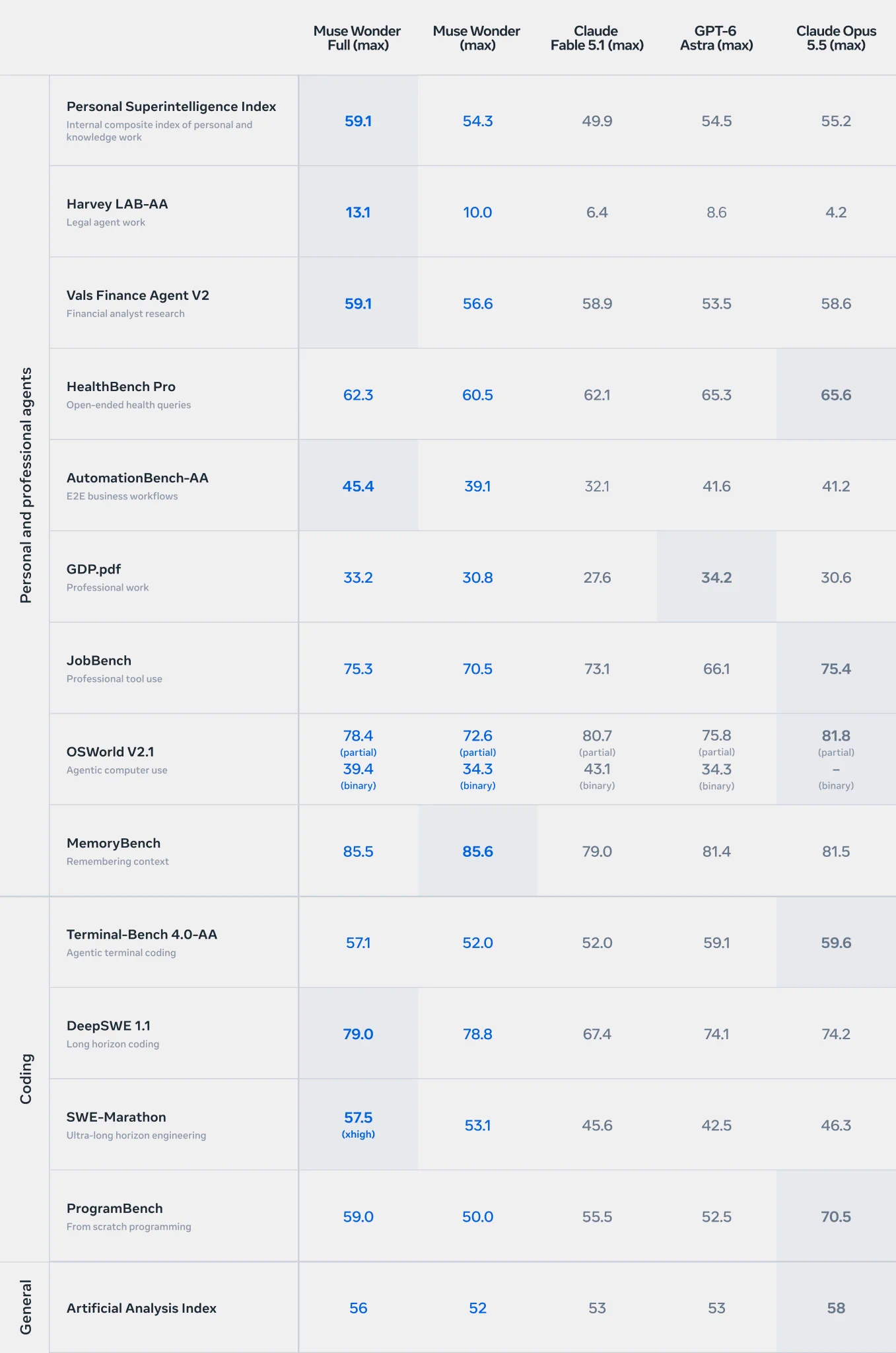 Meta’s benchmark chart comparing Muse Wonder Full and Muse Wonder against Claude Fable 5.1, GPT-6 Astra, and Claude Opus 5.5, shared by Mark Zuckerberg on X.
On Meta’s internal Personal Superintelligence Index, Wonder Full scores 59.1 against 55.2 for Opus 5.5 and 54.5 for GPT-6 Astra. The legal-agent benchmark Harvey LAB-AA shows a wider gap: 13.1 for Wonder Full versus 4.2 to 8.6 for rivals. On MemoryBench, both Wonder models score around 85.5, ahead of Fable (79.0), Astra (81.4), and Opus 5.5 (81.5). Coding is a strong suit: Wonder Full leads SWE-Marathon 57.5 to 46.3 and DeepSWE 1.1 79.0 to 74.2. Meta trails in a few rows: Opus 5.5 leads on ProgramBench (70.5 vs 59.0) and HealthBench Pro, while GPT-6 Astra tops the GDP.pdf professional-work test.
Independent numbers are closer. On the Artificial Analysis Intelligence Index, Wonder Full scores 56, behind Claude Opus 5.5 at 58 and ahead of Fable 5.1, GPT-6 Astra, and Gemini 4 Argon at 53, according to iPhone in Canada’s rundown. The standard Muse Wonder scores 52, tying GPT-6.1 Sol, a large jump from the original Muse Spark’s 31.
The Watermelon Connection
The announcement had a teaser. Earlier Monday morning, Zuckerberg posted a photo of a watermelon that he said his Muse assistant had ordered for him — a post we covered this morning. Investor’s Business Daily reports the Wonder model was previously code-named “Watermelon,” which reframes that post as a launch tease. Meta’s stock climbed more than 4% to $750.53 on the news, per IBD.
What’s Still Unclear
Two caveats from the coverage: Meta’s model weights are closed, and the company says it will publish a report detailing additional safety evaluations later. The safety claims can’t yet be checked against full test results, as the Van Data Team notes. And while Zuckerberg says Wonder will power Muse for subscribers today, Meta hasn’t said when the free tier gets it.
The thread closed with Zuckerberg calling Wonder “a major leap towards delivering personal superintelligence for everyone” and congratulating the team. For Muse users, the practical takeaway is a major intelligence upgrade to the assistant, with subscribers first in line.