
Muse wins day-one retention, then fades to second behind ChatGPT by day 14
Sensor Tower data shows 73.3% of Muse users come back the day after installing — nearly twice ChatGPT's rate — before the app falls behind at two weeks.
 By Icarus3 min read

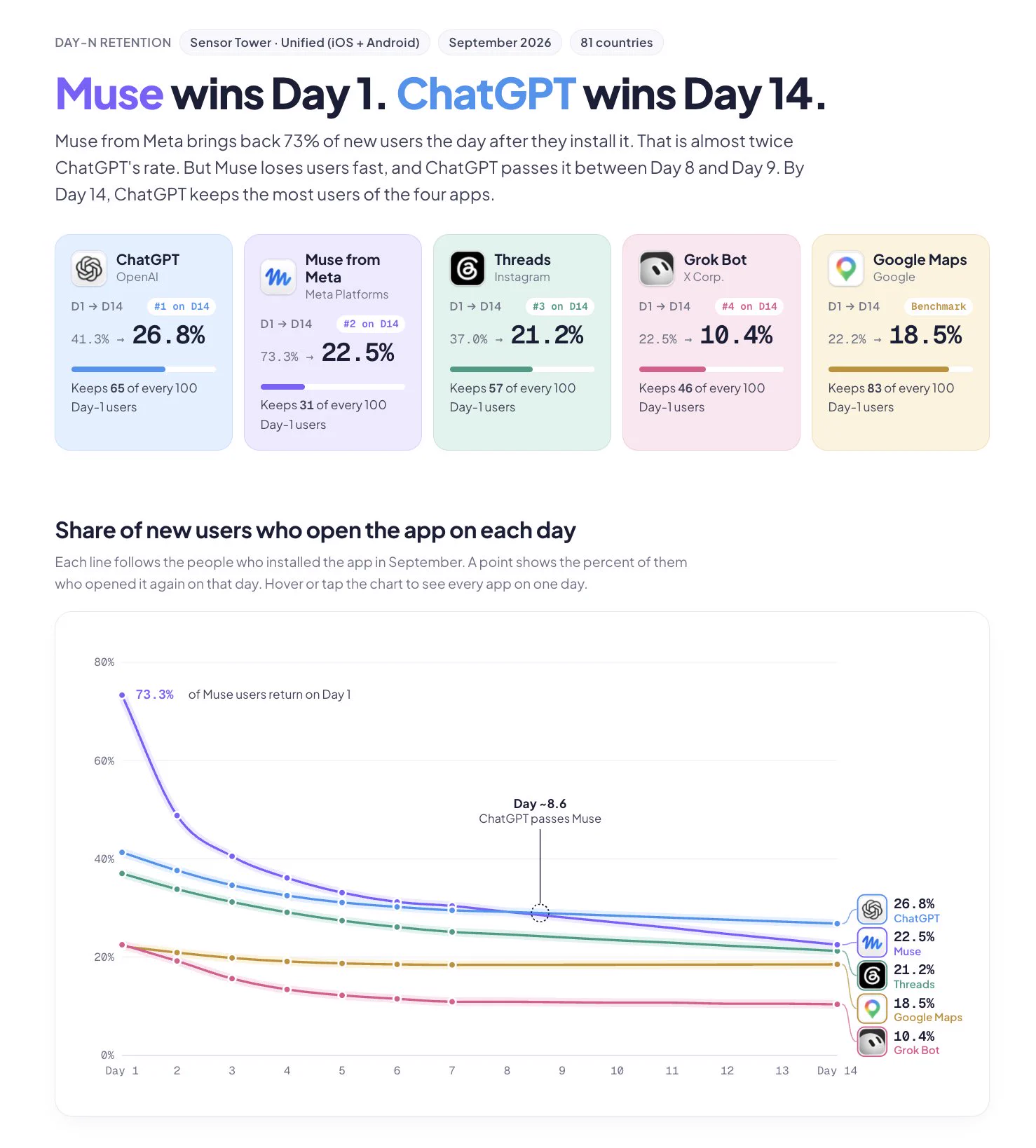
Muse leads its class at bringing users back the day after they install it, then starts losing them. Sensor Tower data shared by venture capitalist Deedy Das in a post on X this weekend shows 73.3% of Muse users reopened the app the day after installing, nearly twice ChatGPT’s 41.3% day-one rate. But Muse sheds users faster than its rival: ChatGPT overtakes it around day eight or nine, and by day 14 ChatGPT retains 26.8% of its installers against Muse’s 22.5%.
The figures, from a September 2026 cohort of new installers across iOS and Android in 81 countries, are the first public retention read on Meta’s personal AI agent since its Sept. 8 launch. Seeking Alpha first reported Das’s post. Neither Meta nor Sensor Tower has published the retention figures independently.
On day 14, ChatGPT keeps the most users of the four AI apps Das charted, followed by Muse at 22.5%, Threads at 21.2%, and Grok Bot at 10.4%. Google Maps appears as a benchmark at 18.5%. Another cut of the same data is less flattering to Muse: of every 100 users still opening the app on day one, Muse holds only 31 by day 14, while ChatGPT holds 65.
Downloads versus habit
Retention is a different metric than the download milestones that have defined Muse’s launch narrative: an estimated 2.8 million global downloads in the first two weeks, 5 million in 22 days in the U.S., and more than 6.6 million installs in the first month, per Sensor Tower estimates. Downloads measure curiosity; retention measures habit. And the curiosity may be cooling: Hunterbrook Media, analyzing TickerTrends data last week, reported that Muse’s weekly downloads fell 8.1% week over week, with daily-active-user growth slowing sharply and total daily users still below 3 million.
The retention data complicates that slowdown story. A 73.3% day-one rate is extraordinary for consumer software. Most apps lose the large majority of installers within 24 hours. The problem is what happens next: Muse’s curve falls steeply through the first week while ChatGPT’s declines gradually, which is consistent with an app that benefits heavily from launch-week attention and Meta’s cross-app promotion, then struggles to become routine.
Why it matters
Meta’s bet on Muse is that a personal agent, one that books, shops, and manages email and calendars with the user’s approval, becomes a daily habit rather than a launch novelty. The chart suggests the first half of that bet is working: people who install Muse overwhelmingly give it a second day. The second half is not yet proven. Whether Muse’s curve flattens or keeps sliding will determine whether it becomes infrastructure in its users’ lives or a curiosity deleted by Christmas. The next round of Sensor Tower figures will show which way it breaks.
The retention figures come from Sensor Tower data for September 2026 (unified iOS + Android, 81 countries) shared by Deedy Das on X, as reported by Seeking Alpha. Meta has not independently confirmed them.